

You might think that gilding is an outdated technique with limited applications. However, it has experienced a resurgence in popularity in recent years and is now used in a variety of applications.
It is quite difficult to obtain metallic pigments and paints that have good covering power and the expected gilded effect, which is why gold leaf is used.
Do you know what gold leaf is used for and how it is used?
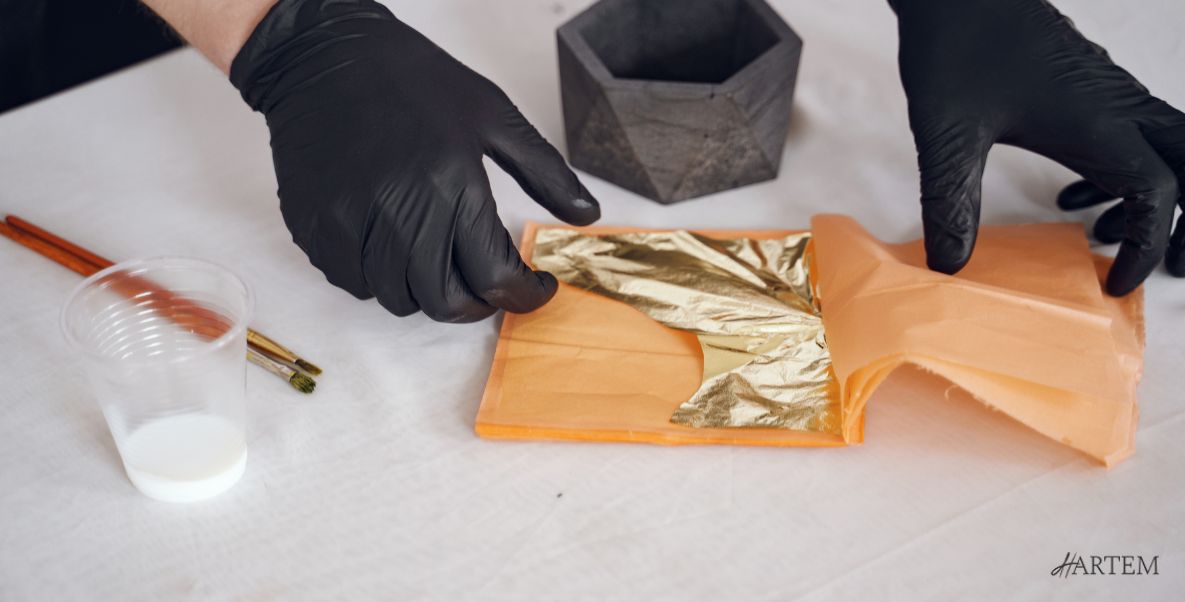
It is a very thin sheet of pure gold or an alloy of gold and other materials. It is used for decoration in fine arts, such as on paintings, sculptures and drawings, as well as on walls and objects, and in all kinds of crafts.
Producing it requires great craftsmanship, sophisticated technology, and in-depth knowledge.
The process involves five stages, from melting the ingot to pressing, beating and cutting it into a thin foil. These foils come in different colours, such as gold, silver or copper, and in various formats made from gold, silver, copper or other real or imitation materials.
Imitation gold leaf is made from aluminium or copper. While its resistance to rust and corrosion is much lower, you can find good quality options.

How is gold leaf used?
Gilding is a complex and laborious technique, with different methods used for different purposes.
Here, we will explain the process most commonly used in fine arts and crafts: mixtion gilding.
- First, prepare the work surface. Make sure it is clean and free of bumps, as this will improve the final result.
- Apply the mixtion in thin layers with a brush. Mixtion is a liquid adhesive specially designed for gilding. It can be water-, alcohol- or varnish-based.
- Leave it to dry sufficiently so that the adhesive 'bites' (i.e. adheres) without getting the bread wet. For water-based mixtion, leave it for around 10–15 minutes.
- Place your gold leaves on the mixtion and apply gentle pressure so that they adhere well to all areas. You can use your hand or a small brush for this.
- Leave to dry for a few minutes until completely dry.
- Use a medium-hardness brush to remove any excess gold leaf.
- Then use a buffing brush to polish the gold leaf for a smoother, shinier, more uniform finish.
- We recommend applying several coats for more uniform results.
- Finally, apply a protective varnish.
Brands such as Giusto Manetti stand out. This family business has been producing gold leaf for over 400 years, becoming a global ambassador for its exceptional quality, tradition, and and innovation. The company offers a wide range of mediums and tools for working with gold, as well as pure and imitation gold, silver, and copper leaf. You can find out more about their products on our website.
If you would like to find out more about this technique, take a look at our Instagram post.


