

Pencils have played a fundamental role in many fields since their earliest appearances in Egyptian and Roman civilisations. The modern pencil, as we know it today, was developed by Josef Hardtmuth in the late 18th century , marking a milestone in the evolution of writing implements. Since then, in addition to graphite pencils, many more varieties have emerged that are part of our daily lives.
Each type of pencil has its own specific properties and uses, tailored to different technical, creative and personal needs. It is therefore important to understand them well so that you can choose the one best suited to your purpose.
Types of pencils for drawing techniques:
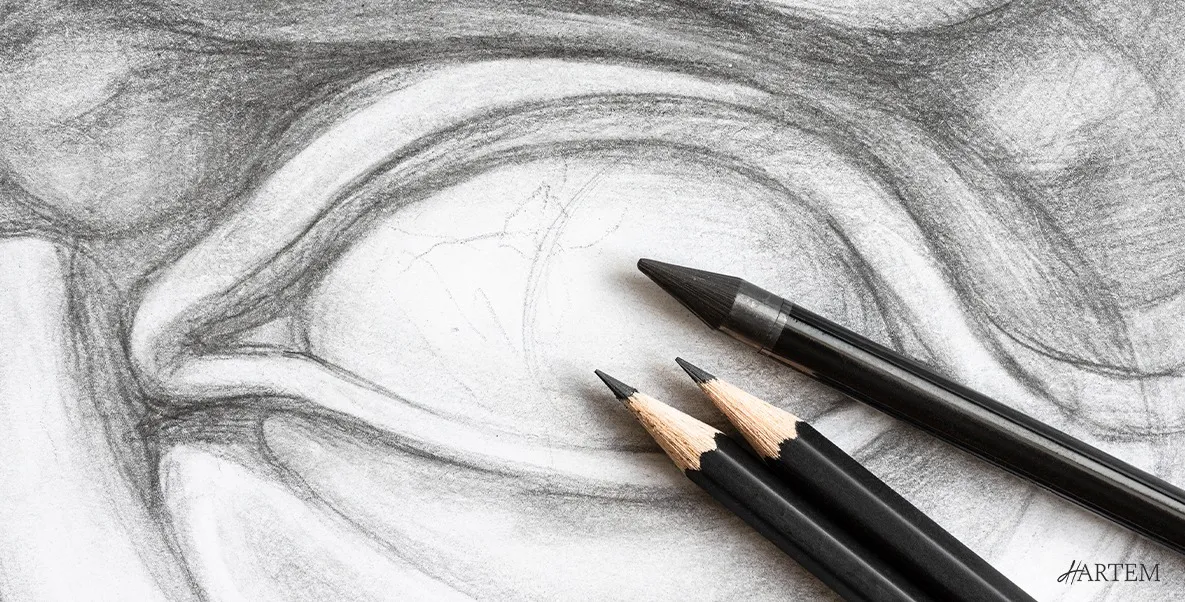
- Graphite pencils: made from graphite powder and clay. The ratio of these two materials determines their hardness and, consequently, the intensity of the line, with a scale comprising more than twenty grades. Known for their versatility, they are ideal for writing, drawing and sketching. They are perfect for technical and artistic drawings on paper, wood or fabric. They allow for quick and easy corrections. With grades ranging from 2B to HB, it is possible to achieve a wide range of greys, from dark tones to finer, softer lines. For harder or softer grades, it is best to experiment until you find the option that best suits your style and needs. The extremes of the scale may be less practical for certain tasks, so they are usually used mainly in professional contexts or by experienced artists. If you need more information on this type of pencil, take a look at our post ‘Types and grades of graphite pencils’.
- Mechanical pencils: These feature refillable leads housed in a plastic or metal barrel and are notable for their ease of use. Their main advantage is that they maintain a consistent line width, do not require sharpening and allow you to replace the lead with others of different hardness, as well as use coloured leads available in a range of thicknesses. Mechanical pencils are characterised by their ergonomic design, lightness and greater durability compared to traditional pencils. They are widely used for sketching, technical drawing and work requiring precision in detail.
- Charcoal pencils: These can be made of charcoal, conté or sanguine for artistic drawing techniques, as they combine the tonal intensity of charcoal sticks with the precision and ease of use of a pencil, offering a cleaner and more manageable alternative for rendering details, sketches and final nuances. These pencils can be used on various surfaces and blend easily; however, due to their composition, they cannot always be erased completely. They are a perfect complement to working alongside drawing sticks. Don’t miss our post ‘Dry techniques: Charcoal, carré and conté’.
- Carpenter’s pencils: These are specialised pencils designed for use in construction, carpentry and other trades. Their main feature is their flat rectangular or triangular shape, which allows them to be placed on various surfaces without rolling away, whilst also ensuring a better grip even when wearing gloves. They require a craft knife or a specific sharpener to sharpen them and feature very sturdy and long-lasting leads, designed to write on uneven and rough materials such as wood, concrete or plasterboard with precision and clarity.
- Dermatographic pencils or Chinese markers: a hybrid between a felt-tip pen and a pencil, which creates marks on almost any porous or non-porous surface, including glass, plastic, film, paper, metal and rubber. They are also water-resistant.
X ![]()
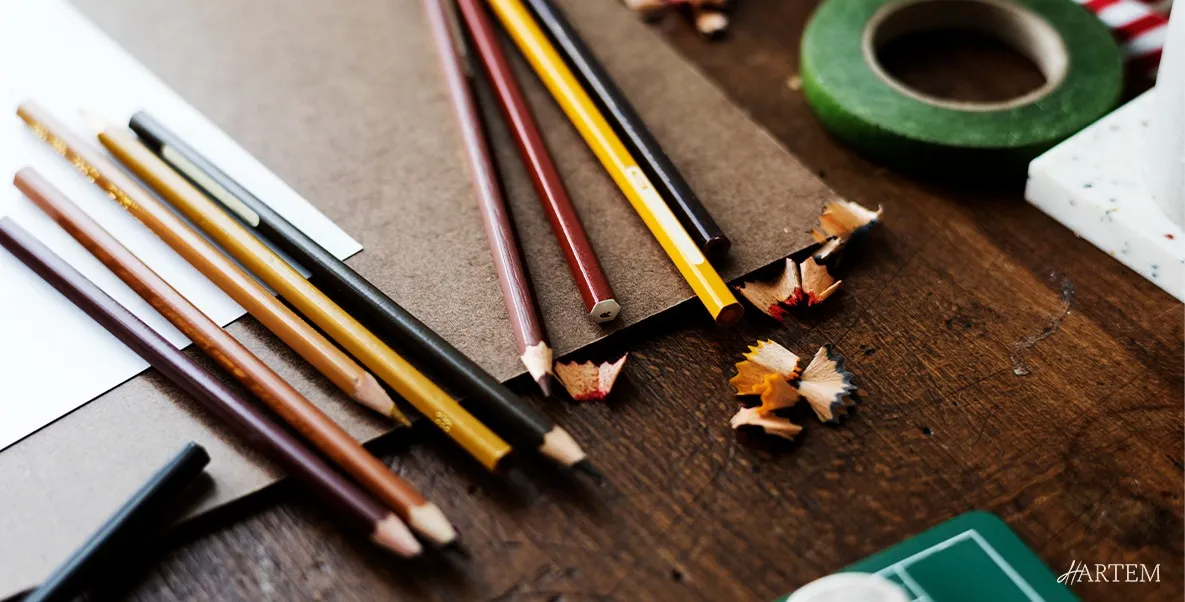
- Coloured pencils: a lead composed of a mixture of pigment, binder and extenders, encased in a wooden barrel. Within this category, there are different variants depending on the composition of the lead:
- -Dyed graphite lead: Combines graphite with coloured pigments and may be watercolour-compatible. This variant offers very interesting colour possibilities with a slight metallic effect.
- -Erasable coloured lead: similar to graphite pencils, but coloured. They can be sharpened and erased, although they do not offer a choice of different hardnesses. Depending on the quality of their components, they may have greater or lesser pigmentation and adhesion. They are used for colouring, drawing or writing on porous surfaces.
- -Wax leads: highly versatile, they can be used on various surfaces but work particularly well on paper. Their colours are very vibrant and soft, and they can be blended together to create smudges and gradients. A notable example of pencils with this type of lead is Prismacolor.
- -Oil-based lead: professional-grade and relatively uncommon, they produce highly saturated colours that blend very well together thanks to their transparency. They can be diluted with solvents or turpentine to achieve painterly effects similar to oil painting.
- -Water-soluble leads: these are made up of soluble carbon and pigment; initially, they can be used just like a conventional coloured pencil, but when water is applied, they produce an effect similar to watercolour, offering intense yet soft colours. Check out our blog post (insert link once it has been written and published).
Ultimately, the wide variety of pencils available, from traditional ones to more specialised options, offers artists an almost limitless range of possibilities. Explore their characteristics and discover how they interact with different techniques and surfaces until you find your favourite.
Products related to this post
Want to give free rein to your creativity? Want to know which products we’ve mentioned in this post? Here they are:


