

is more commonly known by his pen name Okuda San Miguel, or just Okuda.
His primary interest is street art, where he creates large-scale pieces with vivid colour palettes
that deconstruct patterns into geometric shapes.

Infinite Cantabria
Okuda's artistic designs combine shades of grey with a lively multicolor palette,
showcasing geometric structures mixed with organic forms.
The fusion offers its author unquestionable celebrity status and has a noticeable visual impact on the general public.
The public is prompted to ponder issues like existentialism, the universe, infinity, the meaning of life,
and the delusion of freedom in capitalism by means of his creations.
Additionally, they draw attention to a glaring contrast between modernity and our heritage,
particularly between the person and their inherent character.
His favorite subjects center around symbols and ideals like loneliness, self-destruction, resistance to capitalism, and false happiness.
His art is distinguished by vibrant geometric patterns mixed with organic shapes, identity-free bodies, headless creatures,
and a plethora of symbols that collectively produce an exceptional and singular iconographic language that provokes contemplation.
Famous pieces like Bosch's Garden of Earthly Delights and Leonardo da Vinci's Mona Lisa served as inspiration for some of Okuda San Miguel's designs
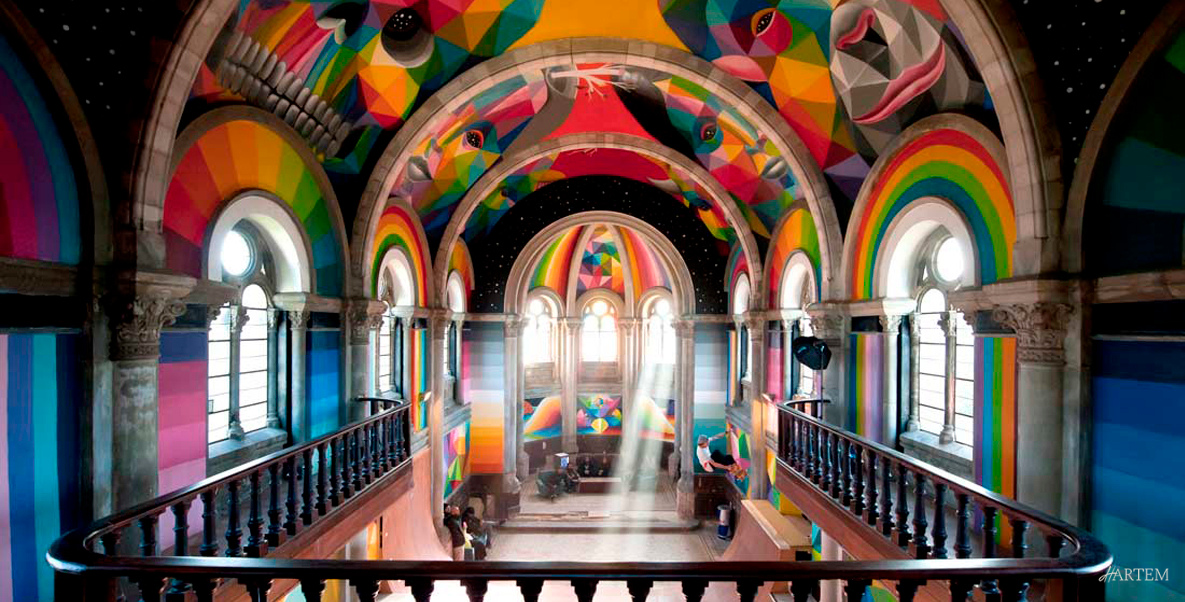
Koas Temple
Pop art, particularly in the forms of fashion and movies, as well as the vivid colors and hues employed by various civilizations,
particularly appeal to Okuda.
All of these components are deftly incorporated into his artistic approach.
The works of this artist can be found in galleries and on the streets all over the world, including in India, Mali, Mozambique,
the United States, Japan, Chile, Brazil, Peru, South Africa, Mexico, and many more
His creation en hartem.
“Deconstruction of the Chromatic Circle”
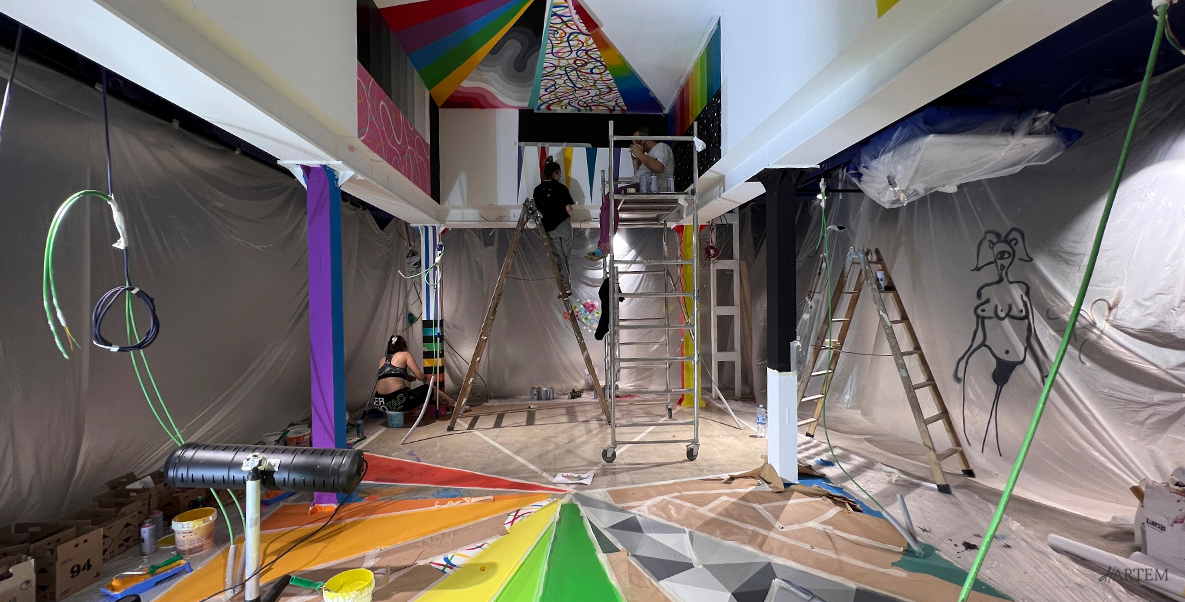
Deconstruction of the Chromatic Circle
The artwork embodies the guiding ideals of Hartem, a specialty store for art supplies that offers creators of all stripes
the tools they need to thrive in the creative process.
Furthermore, Okuda makes use of the color wheel to make color analysis and exploration easier.
The piece utilizes the colour circle and basic ideas seen in classical art in addition to its symbolic quality.
Similar to most classical works of art, the ceiling draws attention with its concentration of
the artist's own themes and colours created by dynamic rays that radiate outward.
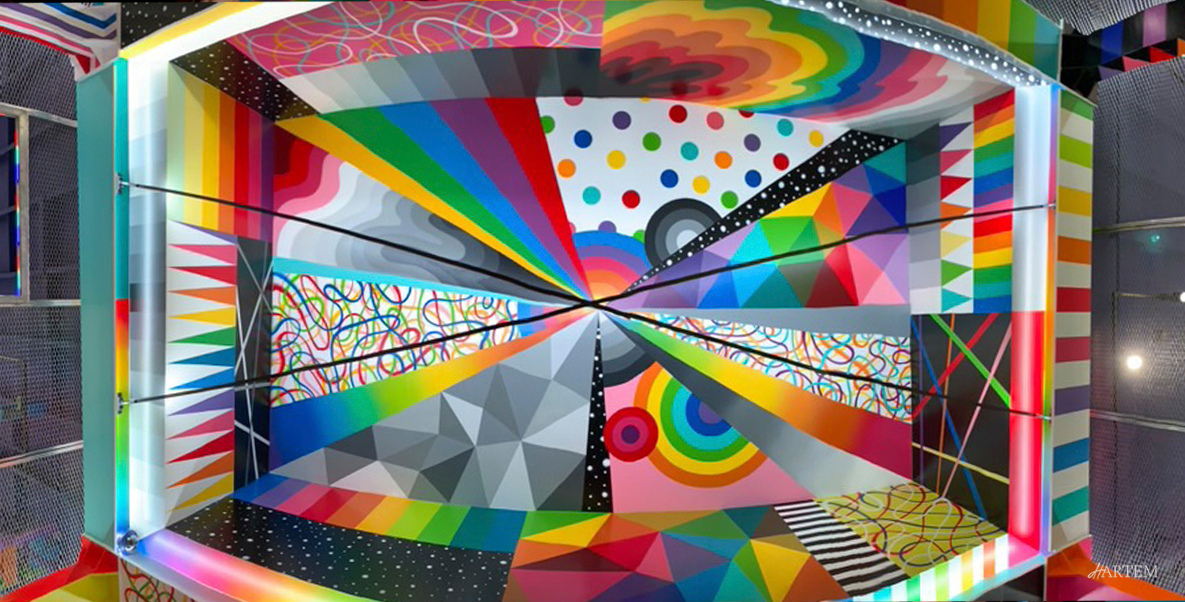
Vault Deconstruction of the Chromatic Circle
By laying one of his signature symbols, the Kaos Star, on the ground, Okuda deftly attempted to reflect the ceiling on the ground.
His search for creativity has yielded several original motifs throughout the years, including triangles, universes, bricks, and the Kaos Star.
Through a variety of materials, the artist is able to communicate principles like independence, inclusivity, and innovation.
Because the star is only represented in greyscale in this instance, the significance of the surrounding colour circle is emphasized.
.
The proposal focuses on two fundamental concepts, classical art and the chromatic circle.


