

The Origin of Klein Blue
Is it possible to register a colour? The answer is no. You cannot register a colour, but you can register a pigment, for example, or any graphic, literary, scientific or musical work.
This is what Yves Klein, the man who painted the world blue, did.
His life was already on the road to art, as his parents had always been involved in painting, but it was not until he met Claude Pascal and Armán Fernández, who taught him about this world and instilled in him its value, that he began to take an interest in this field.
Before dedicating his life to art, he trained in the martial arts. Klein's thoughts followed Eastern philosophies and Zen. Therefore, many of his actions were related to this: he did not paint with brushes because they were too 'impersonal', he created symbolic works or even thought that some things were art just because he touched them.
He understood the power of imagination through idea, form and, above all, colour.
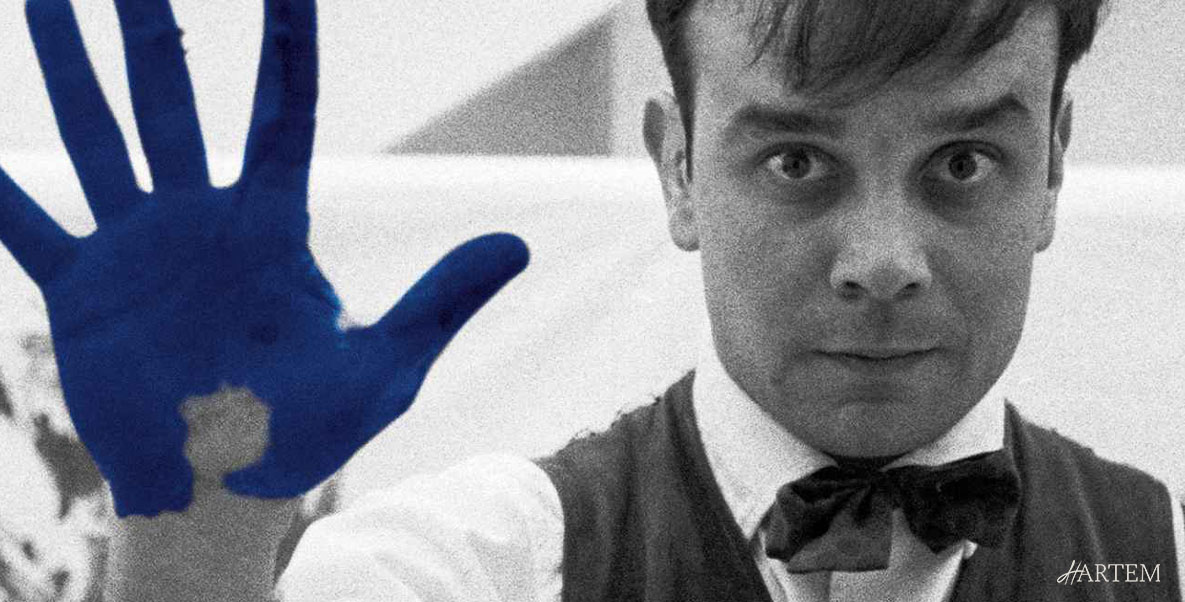
The artist set out to 'liberate colour from the prison of the line' and, motivated by this aim, concentrated on monochrome works, the only form of painting which, for him, 'allowed the absolute to become visible'.
His early works were monochromatic, with the presence of different shades and colours such as pink, gold and blue.
In his search for immateriality and infinity, ultramarine blue was his favourite colour and the one that best served his purpose. But it was not enough, he found it flat and unstable. He wanted a painting that preserved the magic, the brightness and the depth of the sky.
Such was his fixation that the artist, together with Edouard Adam, created a new shade of blue: International Klein Blue (IKB).

Colour properties
The origin of this colour comes from lapis lazuli, a semi-precious stone that was very difficult to extract and was found mainly in Afghanistan, where it was crushed and turned into pigment to be transported by ship. It fetched a higher price than gold. Even the painter Johannes Vermeer put his family into debt to be able to paint with this pigment.
After much research, they succeeded in developing a binder that suspended the pigment particles, Rhodopas M, creating a unique and very peculiar texture that allowed the colour to retain its chromatic intensity, creating a unique colour of its kind.
The new colour became almost the only one he used. It became Yves Klein's trademark.
It ushered in his Blue era and he began to exhibit his first completely monochrome works.

For some experts, Klein's depthless paintings and obsession with emptiness were expressions of the threat of nuclear holocaust. For him, it was imperative to realise that they were living in the atomic age, where all physical matter could disappear at any moment.
And as the artist once said: 'First there is nothing, then there is a deep emptiness and then a blue depth'.
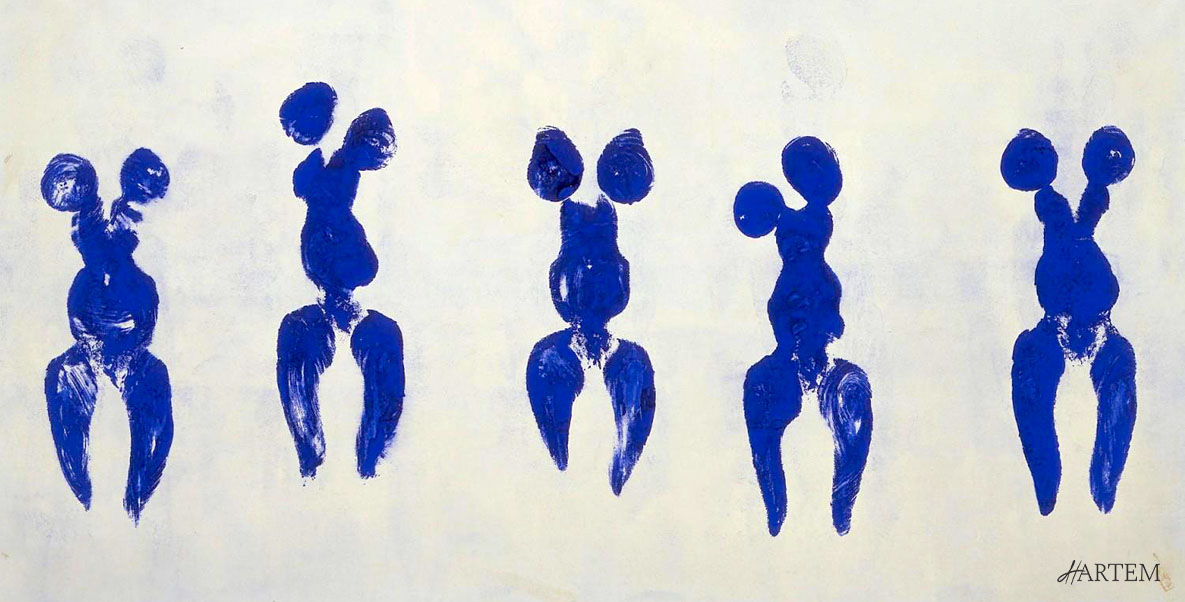
One of his most famous interventions was 'Anthropometries', in which naked women used their bodies as brushes to paint silhouettes on a huge canvas. He preferred not to use brushes in order to avoid any trace of the paint being applied, thus making colour the most important thing in his works. Many of them became real performances.
He also stood out for his "immaterial" works, which consisted of empty spaces that he exchanged for gold, symbolising the exchange between the maximum material value and the minimum. He confronted nature in order to enrich his work and his concept.
Despite his short life, he is considered one of the most innovative and renowned conceptual artists of the 20th century, and the first person in history to legally record a colour.
Thanks to this fact, many others have been able to create and register their own hues. Human creativity is something that will always defy boundaries, and it is thanks to this important quality that we manage to fill life with so much meaning, reinventing the world over and over again, and leaving it coloured by an infinite number of colours.


