


Watercolour is made up of pigments that are diluted in water, creating a more or less opaque surface. This reaction creates different effects. You can build up layers, create glazes, make the watercolour spread, flow with the water, create backgrounds with uniform washes or gradients...
While watercolour and water alone can produce a multitude of results, these are multiplied when you add external elements to which watercolour can react, such as salt.
The technique of using salt in watercolour is very simple because it's a material we all have at hand. It produces very organic looking textures and is suitable for all levels.

How do you use the salt technique?
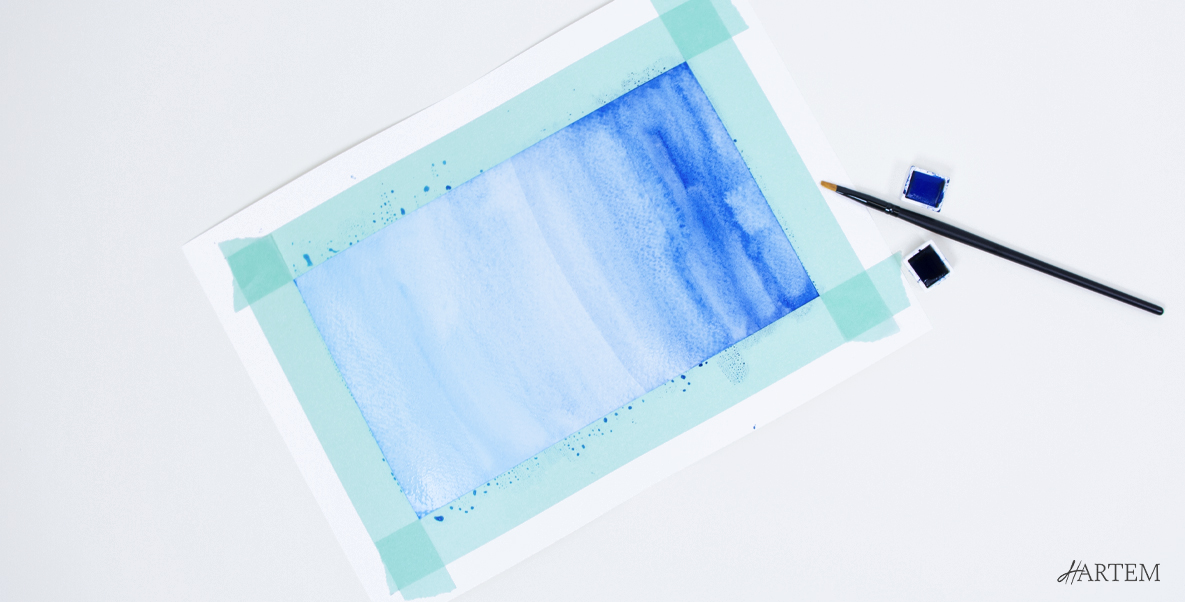
First, once the paper has been prepared and glued to the work surface, we need to wet it with water and a clean brush, as we would with the "wet on wet" technique.
Then we paint with the colours we want, creating our design: an abstract background, a drawing, a landscape, etc. While the sheet is still wet, sprinkle with salt, making sure that the grains of salt are evenly distributed.
Leave to dry completely, then remove any salt that has stuck to the paper with a dry cloth.
You will notice that where the salt was, the colour has become lighter, producing a very interesting visual effect that adds a sense of texture to the work.
Why does salt affect watercolour?
Salt has the ability to absorb liquid and moisture, so when we apply it to wet watercolour, each crystal of salt absorbs the water around it and with it the colour.
This effect cannot be reproduced with a dry brush, as we do when we want to remove water or create lighter areas, because the way the salt absorbs the paint throughout the drying process leaves very characteristic marks.
Our recommendation is that you use the materials specific to each range of paint. Both mediums and varnishes to alter their characteristics as little as possible, as well as specific oil paint brushes, because although we do not need them to be exposed to aggressive materials, we need them to conserve all their properties so that the way of working is exactly the same as the traditional way.
Factors that can influence the result of the watercolour and salt technique.
However, it is very difficult to control the result we get because it depends on many factors.
Firstly, the type of paper. Since we are working with a large amount of water, we will obviously need a special high grammage watercolour paper. But the absorbency will vary depending on the brand or composition of the paper. The more water the paper absorbs, the less colour will be absorbed by the salt and the effect may be less pronounced.
On the other hand, the amount of water we use in our ink also has an effect. The less water we use, the less eye-catching the result will be, as the salt will not have much moisture to absorb and much of the colour will remain on the paper.
Another factor to consider is the type of salt you use: table salt, coarse salt, flakes... Each will give a different effect. We can experiment with each and choose one or the other depending on what we are looking for.
Finally, the ambient temperature can also have an effect, although to a lesser extent, when using this technique. If we are in a hot season, the watercolour will dry faster. This is why, with the same materials, we can see differences in our work when we do it at different times of the year.

Experiment, try, have fun!
Art is made to be enjoyed, so don't be afraid to try it. Relax, let the colour flow, and surprise yourself with the effects achieved by using the salt technique in watercolour. Creativity is worked on day by day, so grab your brushes and get to work!


