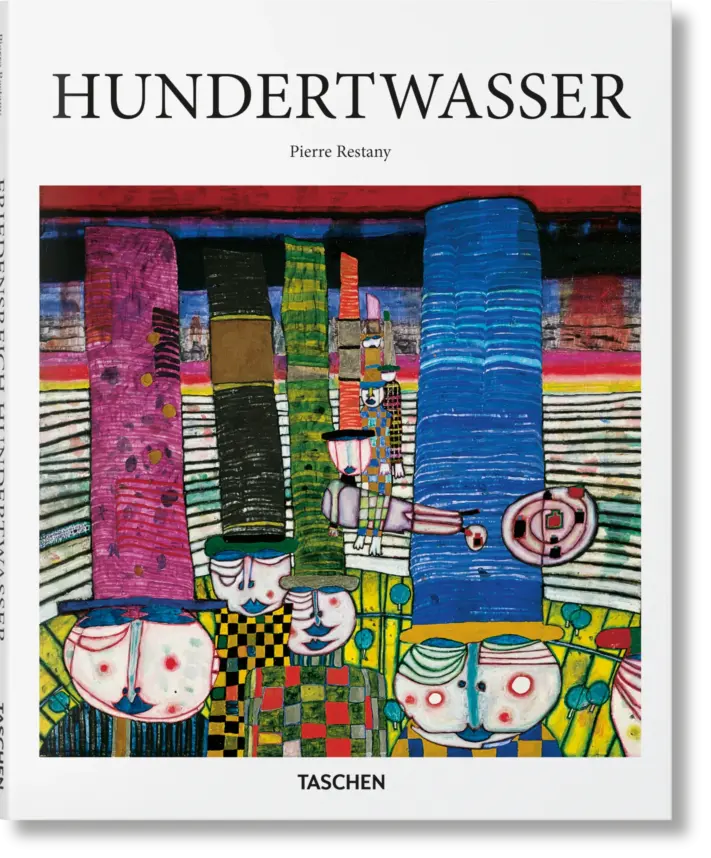
Basic Art Series Hundertwasser P Restany English is available to buy in increments of 1
Add to Wish List
Hundertwasser: 1928-2000: the Power of Art - the Painter-king With the Five Skins
Architect, artist and visionary environmentalist, Friedensreich Hundertwasser left behind an unmistakable trail of imagination and activism that took the form of buildings, paintings and manifestos. From nude speeches, support for tree-planting campaigns to the Hundertwasserhaus in Vienna, he always confronted any narrow-mindedness, and his field of action was as much society as a whole as an individual building.
Spiral of ideas
Friedensreich Hundertwasser, the master of flowing forms and ecologism
Bright colours, organic forms and the rejection of straight lines are some of the most representative characteristics of the unique work of Friedensreich Hundertwasser (1928-2000). A champion of non-conformism, this artist, architect and activist left a trail of imagination and innovative ideas that materialised in buildings, paintings, manifestos and actions, among other activities. One of his best-known works is the Hundertwasserhaus in Vienna, a structural synthesis of the vitality and uniqueness that marked the artist's entire oeuvre. Hundertwasser believed that rational, sterile and monotonous buildings brought misery to people. He called for a boycott of the modernist paradigm championed by Adolf Loos, among others, and advocated an architecture based on creative freedom and ecological commitment. Hundertwasser was fiercely opposed to straight lines, which he called impious and immoral, and was fascinated by the spiral and secessionist forms of Klimt and Schiele. This lavishly illustrated book deals with Hundertwasser's style and vision for each of his buildings and society in general. From the speeches he gave in the nude in the late 1960s to his universally oriented architectural designs and alternative projects for society, author Pierre Restan explores Hundertwasser's achievements and innovative ideas in an exciting introduction to the work of a 20th-century pioneer.
About the author
Pierre Restany (1930-2003) spent his youth in Morocco, before studying in France, Italy and Ireland. From 1963 he collaborated with the architectural magazine Mus and from 1985 he edited the magazine D'ARS. In 1955, he met Yves Klein, which led him to the theory of the "new realism", which he would put forward in 1960, the year of the creation of the group of artists of the same name. He is the author of numerous publications on 20th century art.
You are trying to visit Hartem USA website. Do you want to continue on this website?
https://hartem.com/en-us/hundertwasser-basic-art-series.html158690Basic Art Series Hundertwasser P Restany English<p>Hundertwasser: 1928-2000: the Power of Art - the Painter-king With the Five Skins</p><p>Architect, artist and visionary environmentalist, Friedensreich Hundertwasser left behind an unmistakable trail of imagination and activism that took the form of buildings, paintings and manifestos. From nude speeches, support for tree-planting campaigns to the Hundertwasserhaus in Vienna, he always confronted any narrow-mindedness, and his field of action was as much society as a whole as an individual building.</p><p>Spiral of ideas</p><p>Friedensreich Hundertwasser, the master of flowing forms and ecologism</p><p>Bright colours, organic forms and the rejection of straight lines are some of the most representative characteristics of the unique work of Friedensreich Hundertwasser (1928-2000). A champion of non-conformism, this artist, architect and activist left a trail of imagination and innovative ideas that materialised in buildings, paintings, manifestos and actions, among other activities.<br/>One of his best-known works is the Hundertwasserhaus in Vienna, a structural synthesis of the vitality and uniqueness that marked the artist's entire oeuvre. Hundertwasser believed that rational, sterile and monotonous buildings brought misery to people. He called for a boycott of the modernist paradigm championed by Adolf Loos, among others, and advocated an architecture based on creative freedom and ecological commitment. Hundertwasser was fiercely opposed to straight lines, which he called impious and immoral, and was fascinated by the spiral and secessionist forms of Klimt and Schiele.<br/>This lavishly illustrated book deals with Hundertwasser's style and vision for each of his buildings and society in general. From the speeches he gave in the nude in the late 1960s to his universally oriented architectural designs and alternative projects for society, author Pierre Restan explores Hundertwasser's achievements and innovative ideas in an exciting introduction to the work of a 20th-century pioneer.</p><p>About the author</p><p>Pierre Restany (1930-2003) spent his youth in Morocco, before studying in France, Italy and Ireland. From 1963 he collaborated with the architectural magazine Mus and from 1985 he edited the magazine D'ARS. In 1955, he met Yves Klein, which led him to the theory of the "new realism", which he would put forward in 1960, the year of the creation of the group of artists of the same name. He is the author of numerous publications on 20th century art.</p><li>Pages: 96</li><li>Language: English</li><li>Author: Pierre Restany</li><li>Year: 2018</li><li>MODEL: 9783836564212</li><p>Publisher: Taschen</p>https://static.hartem.com/media/catalog/product/a/1/Warhol_2.webp0instock23.44010023.44000https://static.hartem.com/media/catalog/product/a/1/Warhol_2.webp/Libros, revistas y publicaciones/Taschen/Hartem, Fine Arts/Hartem, Fine Arts/Libros/Hartem, Fine Arts/Libros/Libros de teoría del color y el arte1743166177000