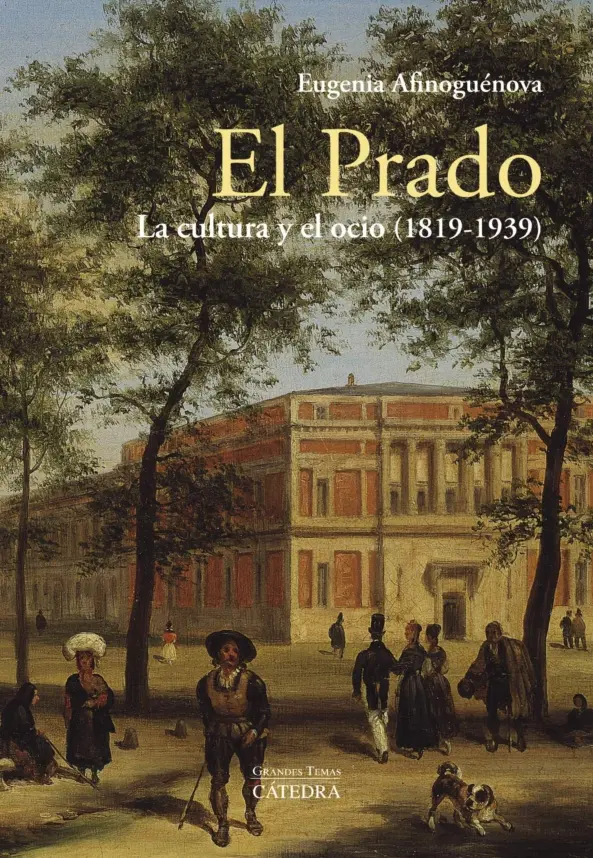
The origins and development of the Museo del Prado are inseparable from the debates about the fate of the liberal state in Spain, the evolution of museum ideas in Europe and the amalgam of experiences offered by the Paseo del Prado. Without assuming that its visitors ever agreed on how to interpret the museum, this book approaches its history as that of a public debate with many voices. Like those visitors who crossed the threshold of the museum and did not always draw a clear line between what they could see or do inside and outside the building, in and around the Paseo del Prado, the participants in this debate saw the museum visit as a pastime intimately connected to other public activities and thus part of a wider debate about citizenship and voting rights, Madrid's rise to the status of modern capital, and the growing gap between town and country. Following the exhausting pace of modernisation, the museum and the Paseo del Prado co-evolved in ways that made leisure as relevant a phenomenon as so many others studied by museum historians: the changes in the exhibitions and collections, the refurbishment of the building and the changing definitions of Castilian national consciousness.
Language: Spanish
Pages: 376
More Information
Brand
Editorial
Materia
Color
Idioma
Español
El Prado la cultura y el ocio 1819-1939 E Afinoguénova Spanish
You are trying to visit Hartem USA website. Do you want to continue on this website?
https://hartem.com/en-us/el-prado-culture-and-leisure-1819-1939.html154412El Prado la cultura y el ocio 1819-1939 E Afinoguénova Spanish<p>The origins and development of the Museo del Prado are inseparable from the debates about the fate of the liberal state in Spain, the evolution of museum ideas in Europe and the amalgam of experiences offered by the Paseo del Prado. Without assuming that its visitors ever agreed on how to interpret the museum, this book approaches its history as that of a public debate with many voices. Like those visitors who crossed the threshold of the museum and did not always draw a clear line between what they could see or do inside and outside the building, in and around the Paseo del Prado, the participants in this debate saw the museum visit as a pastime intimately connected to other public activities and thus part of a wider debate about citizenship and voting rights, Madrid's rise to the status of modern capital, and the growing gap between town and country. Following the exhausting pace of modernisation, the museum and the Paseo del Prado co-evolved in ways that made leisure as relevant a phenomenon as so many others studied by museum historians: the changes in the exhibitions and collections, the refurbishment of the building and the changing definitions of Castilian national consciousness.</p><p>Language: Spanish</p><p>Pages: 376</p>https://static.hartem.com/media/catalog/product/e/l/Murillo-y-las-metaforas-de-la-imagen-13122024130146.webp0outofstock28.13010028.13000https://static.hartem.com/media/catalog/product/e/l/Murillo-y-las-metaforas-de-la-imagen-13122024130146.webp/Libros de teoría del color y el arte/Editorial1734178190000