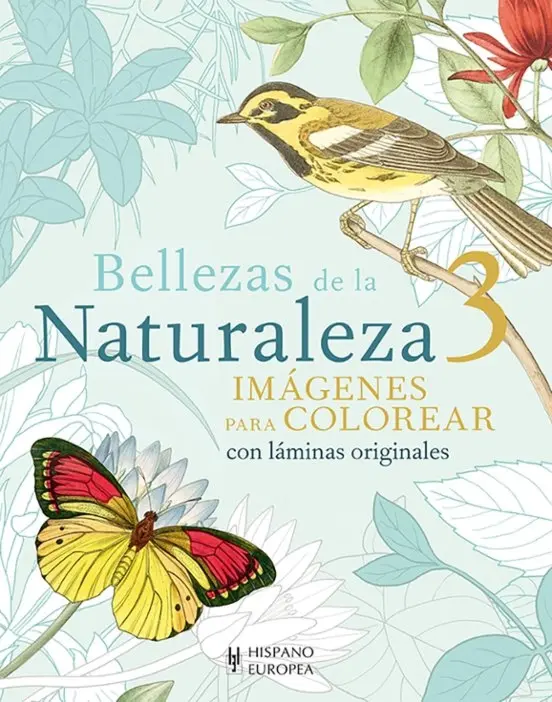
Images of the natural world have always fascinated people. Birds, butterflies, flowers and fish are wonderful subjects to paint and draw. An easy way to practice your artistic skills is to colour, which will quickly reward you with a pleasing result. And the best way to learn art is to copy the work of a master. The plates in this book are taken from a variety of historical sources.
The flowers are from Choix des Plus Belles Fleurs by Pierre-Joseph Redouté, published in 1827. The birds are from two sources: A History of the Birds of Europe (1871) by S.E. Dresser, and The Birds of America (18401844) by John T. Bowen and John James Audubon. For butterflies and fish, we turn to The Naturalist s Library, which was edited by the great Scottish naturalist Sir William Jardine (18001874).
The illustrations were engraved by William Lizars (17881859). The choice of art materials you can use for colouring is wide: oil-based, wax-based or water-soluble crayons give excellent results. You can use them dry, smudging them with your fingers or a paper stump, or dilute them with oil, or water for water-soluble pencils. Whichever medium you choose, you will enjoy many hours of colouring these beauties of Nature.
You are trying to visit Hartem USA website. Do you want to continue on this website?
https://hartem.com/en-us/beauties-of-nature-3.html157239Bellezas de la Naturaleza 3 Miscellaneous Spanish
<p>Beauties of Nature 3</p>
<ul>
<li>
<p>Images of the natural world have always fascinated people. Birds, butterflies, flowers and fish are wonderful subjects to paint and draw. An easy way to practice your artistic skills is to colour, which will quickly reward you with a pleasing result. And the best way to learn art is to copy the work of a master. The plates in this book are taken from a variety of historical sources.</p>
</li>
<li>
<p>The flowers are from Choix des Plus Belles Fleurs by Pierre-Joseph Redouté, published in 1827. The birds are from two sources: A History of the Birds of Europe (1871) by S.E. Dresser, and The Birds of America (18401844) by John T. Bowen and John James Audubon. For butterflies and fish, we turn to The Naturalist s Library, which was edited by the great Scottish naturalist Sir William Jardine (18001874).</p>
</li>
<li>
<p>The illustrations were engraved by William Lizars (17881859). The choice of art materials you can use for colouring is wide: oil-based, wax-based or water-soluble crayons give excellent results. You can use them dry, smudging them with your fingers or a paper stump, or dilute them with oil, or water for water-soluble pencils. Whichever medium you choose, you will enjoy many hours of colouring these beauties of Nature.</p>
</li>
<li>Text in Spanish</li>
</ul>
<p>Publisher: Editorial Hispano Europea</p>https://static.hartem.com/media/catalog/product/9/7/The-Path-of-Drawing-05032025154159.webp0outofstock15010015000https://static.hartem.com/media/catalog/product/9/7/The-Path-of-Drawing-05032025154159.webp/Hartem, Fine Arts/Libros/Hartem, Fine Arts/Editorial/Hartem, Fine Arts/Libros/Libros de colorear/Colorear para adultos1741223591000