There are no reviews about this product yet
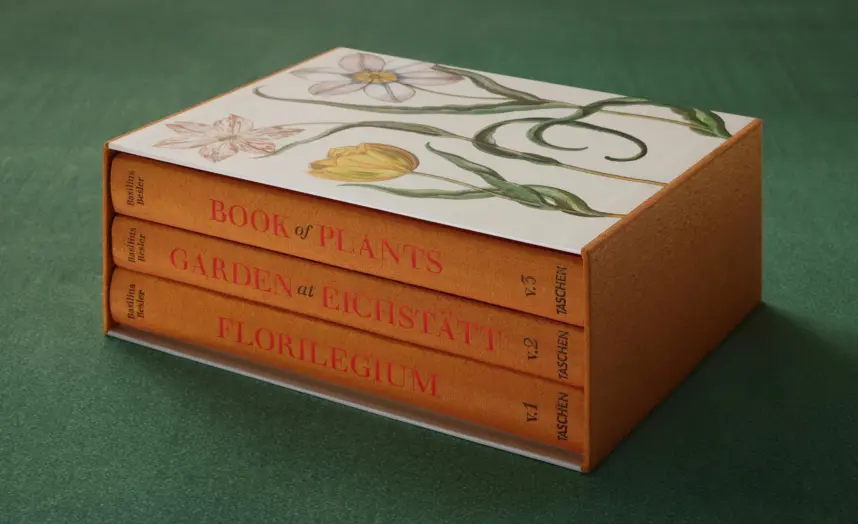
The 367 hand-coloured plates of the Hortius Eystettensis, published in 1613 with elaborate descriptions to document the palace gardens in Eichstätt (Bavaria), were a landmark of botanical illustration. This facsimile edition, with an up-to-date classification system and expert texts, preserves a valuable collection for posterity.
Botanical beauty
Complete facsimile edition of the three volumes of the Hortenus Eystettensis
When Prince-Bishop Johann Konrad von Gemmingen (1593/95-1612) undertook a radical renovation of Willibaldsburg Castle overlooking the Altmühl River in Eichstätt (Bavaria), he also created a palace garden of great magnificence around it. In order to preserve the garden for future generations - and to provide a permanent catalogue of its contents, compiling plants from the four seasons and presenting them in that order - he commissioned the garden's director, the Nuremberg apothecary Basilius Besler (1561-1629), and a team of engravers to immortalise its treasures in a collection of printed plates.
The result was the Hortus Eystettensis, published in Nuremberg in 1613. With its 367 hand-coloured plates and detailed descriptions, it was a work of meticulous execution and spectacular diversity, remarkably expensive for the time. As the garden contained plants imported from exotic places, the three volumes exhibited remarkable variety, with a total of 90 families and 340 genera. Because of the decorative and stylised execution of these illustrations, where plants begin to be seen in aesthetic rather than merely practical or medicinal terms, the book is considered a milestone in the art of botanical illustration. Although it was published before the advent of standardised classification systems, Carl Linnaeus himself later described it as an "incomparable work".
Besler's catalogue outlived the gardens, which were destroyed in 1634 by invading Swedish troops during the Thirty Years' War. However, a lengthy redevelopment project at the historic site culminated in the opening of the modern Bastionsgarten in 1998, which contains many of the plants displayed in the Hortus Eystettensis.
This facsimile edition presents high-quality reproductions of these impressive illustrations, based on the copy of the Hortus Eystettensis in the library of the University of Eichstätt-Ingolstadt, and is accompanied by detailed descriptions of the botanical, pharmaceutical and symbolic significance of each plant and an appendix with essays that place the garden and the book in their historical contexts.
This edition presents a valuable work of botanical literature which, on the rare occasions when an original copy appears on the market, can fetch over a million dollars at auction. In line with Besler's original intention, this facsimile makes the garden available to a wider public and preserves it for posterity.
About the authors
Klaus Walter Littgerwas deputy director of the library of the University of Eichstätt-Ingolstadt and director of its collection of historical books and manuscripts. In addition to essays on German language and literature, he has published numerous works on the history of libraries, as well as on the diocese and university of Eichstätt and on the history of local music. He is also co-editor of a magazine and a series on the history of the diocese.
Werner Dressendörferes is a pharmaceutical historian, academic librarian and former honorary professor at the University of Erlangen-Nuremberg. His special interests are the history of herbology in the modern age, the cultural history of medicinal plants and the symbolism of plants in art. He has published numerous articles on the history of pharmacy and botany and is the author of The Garden at Eichstätt, The Lilies, Leonhart Fuchs: The New Herbal of 1543, Pomona Britannica, The Temple of Flora, and The Vegetable Garden, published by TASCHEN.
- Pages: 1096
- Language: English
- Author: Klaus Walter Littger, Werner Dressendörfer
- ISBN: 9783836594332
- Year: 2022
Publisher: Taschen



| Brand | Taschen |
|---|---|
| Idioma | Alemán, Francés, Inglés |