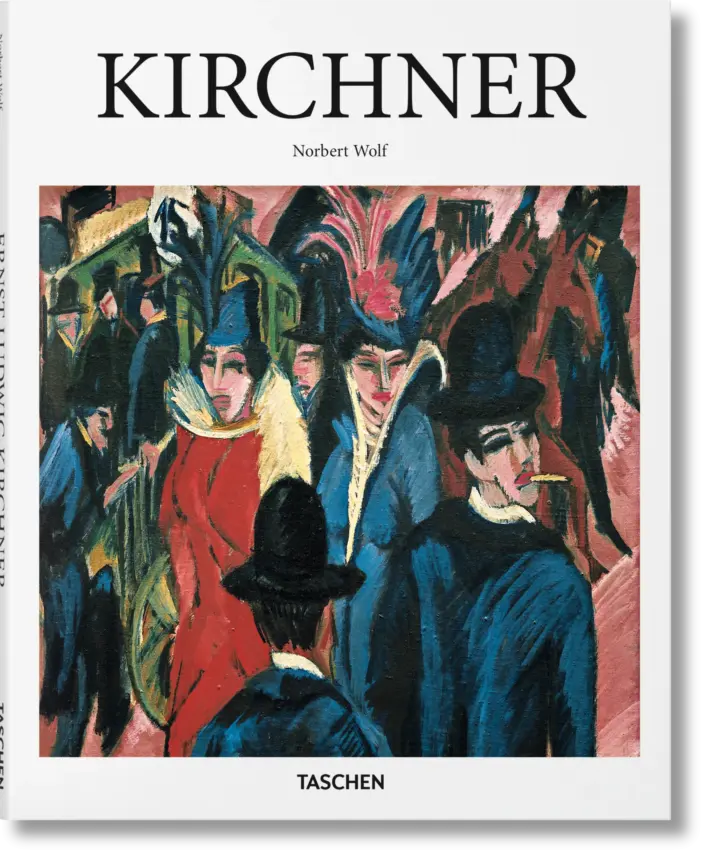
Basic Art Series Kirchner N Wolf English is available to buy in increments of 1
Add to Wish List
Ernst Ludwig Kirchner was a pioneer of German Expressionism, a prolific painter, printmaker and co-founder of the Die Brücke (The Bridge) art movement. Through vibrant landscapes, elegant nudes and dynamic urban scenes, this book explores the radical nature of his painting in pre-World War I Germany and his seminal influence on 20th-century art.
Building bridges
Expressionist pioneer Ernst Ludwig Kirchner broke new ground in 20th-century painting.
Ernst Ludwig Kirchner (1880-1938) is considered one of the key figures of 20th century European art. A modernist to the core, he caused an earthquake in the art world with his images of sharp contours and intense colours, spreading his ideas through the Die Brücke (The Bridge) movement and the MUIM-Institut school of modern painting, of which he was co-founder. Kirchner's work reconciled past and present through an expressionist prism, reflecting the latest avant-garde ideas in the artistic field, while exploring traditional academic issues and approaches. Distorted perspectives, hard lines and unusual colours were the mainstays of his work, as was a recurring interest in capturing the human form, whether in lively urban views such as Scene from a Berlin Street (1913) or in his famously decadent studio. In this introductory book we explore the period of Kirchner's career that took him through Germany and Switzerland, including the founding of Die Brücke and his inclusion in the infamous Degenerate Art exhibition organised by the Nazis in 1937. Along the way, we find lively landscapes, elegant nudes, intense urban scenes and, above all, a persistent emphasis on the emotional experience of both the painter and the viewer.
About the author
Norbert Wolf graduated in art history, linguistics and medieval studies at the universities of Regensburg and Munich. He received his doctorate in art history in 1983. In 1992 he wrote his professorial thesis in Munich on 14th century carved altarpieces. Subsequently he has been a visiting professor in Marburg, Frankfurt am Main, Leipzig, Düsseldorf, Erlangen-Nuremberg and Innsbruck. He has written extensively on art history, including many titles in TASCHEN, such asDiego Velázquez, Ernst Ludwig Kirchner, Caspar David Friedrich, Expressionism, Romanesque Art, Landscape Painting and Symbolism.
You are trying to visit Hartem Europe website. Do you want to continue on this website?
https://hartem.com/en-ie/ernst-luwig-kirchner-1880-1938-on-the-edge-of-the-obyss-of-time.html158548Basic Art Series Kirchner N Wolf English<p>Ernst Ludwig Kirchner was a pioneer of German Expressionism, a prolific painter, printmaker and co-founder of the Die Brücke (The Bridge) art movement. Through vibrant landscapes, elegant nudes and dynamic urban scenes, this book explores the radical nature of his painting in pre-World War I Germany and his seminal influence on 20th-century art.</p><p>Building bridges</p><p>Expressionist pioneer Ernst Ludwig Kirchner broke new ground in 20th-century painting.</p><p>Ernst Ludwig Kirchner (1880-1938) is considered one of the key figures of 20th century European art. A modernist to the core, he caused an earthquake in the art world with his images of sharp contours and intense colours, spreading his ideas through the Die Brücke (The Bridge) movement and the MUIM-Institut school of modern painting, of which he was co-founder.<br/>Kirchner's work reconciled past and present through an expressionist prism, reflecting the latest avant-garde ideas in the artistic field, while exploring traditional academic issues and approaches. Distorted perspectives, hard lines and unusual colours were the mainstays of his work, as was a recurring interest in capturing the human form, whether in lively urban views such as Scene from a Berlin Street (1913) or in his famously decadent studio.<br/>In this introductory book we explore the period of Kirchner's career that took him through Germany and Switzerland, including the founding of Die Brücke and his inclusion in the infamous Degenerate Art exhibition organised by the Nazis in 1937. Along the way, we find lively landscapes, elegant nudes, intense urban scenes and, above all, a persistent emphasis on the emotional experience of both the painter and the viewer.</p><p>About the author</p><p>Norbert Wolf graduated in art history, linguistics and medieval studies at the universities of Regensburg and Munich. He received his doctorate in art history in 1983. In 1992 he wrote his professorial thesis in Munich on 14th century carved altarpieces. Subsequently he has been a visiting professor in Marburg, Frankfurt am Main, Leipzig, Düsseldorf, Erlangen-Nuremberg and Innsbruck. He has written extensively on art history, including many titles in TASCHEN, such asDiego Velázquez, Ernst Ludwig Kirchner, Caspar David Friedrich, Expressionism, Romanesque Art, Landscape Painting and Symbolism.</p><li>Pages: </li><li>Language: English</li><li>Author: Norbert Wolf</li><li>Year: </li><li>ISBN: 9783836535045</li><p>Publisher: Taschen</p>https://static.hartem.com/media/catalog/product/7/a/Klimt_2.webp0instock15010015000https://static.hartem.com/media/catalog/product/7/a/Klimt_2.webp/Libros, revistas y publicaciones/Taschen/Fine Arts Books/Fine Arts Books/Colour and Art Theory Books1742993922000