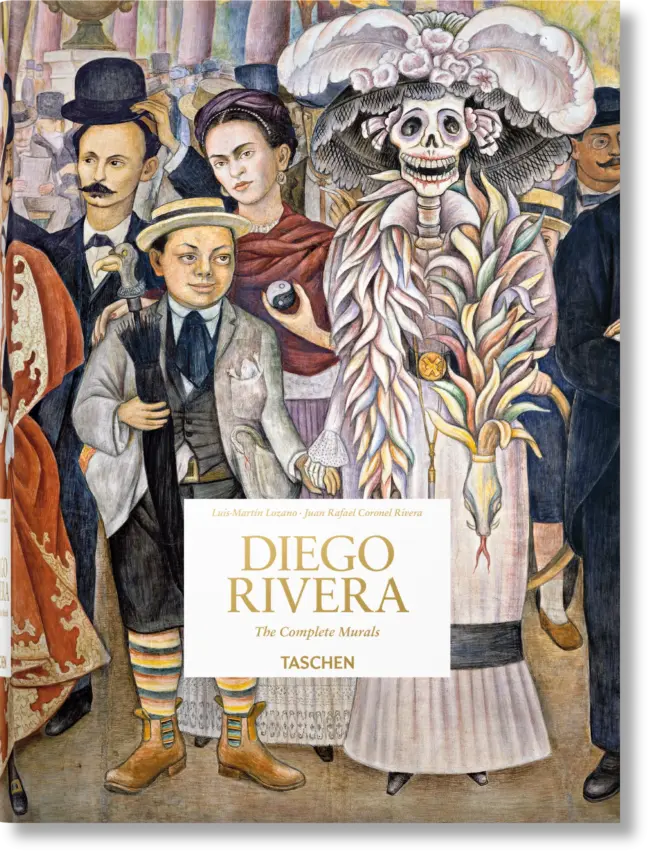
This is Diego Rivera: Latin American folk hero, husband of Frida Kahlo and one of Mexico's most important artists. His large-scale murals depicting social change still decorate prominent public buildings in Mexico today. Thanks to specially produced photographs, this volume provides a detailed look at Rivera's work.
Diego in detail
The most ambitious monograph to date on Rivera's work.
A true folk hero in Latin America and Mexico's most important artist, along with his wife, the painter Frida Kahlo, Diego Rivera (1886-1957) led a passionate life devoted to art and communism. After spending a few years (in the 1910s) in Europe, where he surrounded himself with other artists and embraced the Cubist movement, he returned to Mexico and began painting the large-scale murals that made him famous. In them he addressed social and political themes related to the working class, earning him a prophetic status among the peasants of his country. He was invited to create pieces abroad, especially in the United States, where he provoked controversy by depicting Lenin in a mural for Rockefeller Center in New York (which was destroyed before it was completed). Rivera's most notable work is his 1932 Detroit Industry, a group of 27 frescoes at the Detroit Institute of Art in Michigan. This volume presents numerous large-scale details of the murals, allowing their various components and subtleties to be closely examined. In addition to these, it includes a large selection of paintings, period photographs, documents and drawings from public and private collections around the world, many of which were previously unknown to scholars and whose inclusion has been made possible by the most intensive research into Rivera's work since his death. The texts include an illustrated biography and essays by leading art historians offering interpretations of each mural. One could not ask for a more comprehensive study of Rivera's work, and finally his work gets the retrospective it deserves.
About the authors
Juan Rafael Coronel Rivera, grandson of Diego Rivera, has worked as an editor for the magazines Punto Cero en Literatura, El Faro revista de literaturayarte and M'hija, together with Carlos Jaurena. In 1987 he founded Kahlo-Coronel Fotogalería, the first photographic gallery in Mexico. His collection of Mexican folk pottery, which includes more than 15,000 pieces from the 16th century to the present day, is the largest in the world. He has curated more than 100 exhibitions for art galleries, museums, and biennials, and has written 71 publications.
Luis-Martín Lozano is an art historian. His research focuses on analysing the creative processes of artists within the parameters of modernity in Mexico and Latin America. He was awarded a Fulbright scholarship and has conducted extensive research on the work of Frida Kahlo and Diego Rivera and is the author of numerous publications on both artists. Lozano was director of the Museo de Arte Moderno de México and has collaborated as a guest curator with different art institutions in the United States, Europe, Asia, Latin America and, above all, in Mexico.
Pages: 640
Language: English
Author: Luis-Martín Lozano, Juan Rafael Coronel Rivera
You are trying to visit Hartem Europe website. Do you want to continue on this website?
https://hartem.com/en-ie/diego-rivera-the-complete-murals.html158529Diego Rivera the Complete Murals Various English<p>This is Diego Rivera: Latin American folk hero, husband of Frida Kahlo and one of Mexico's most important artists. His large-scale murals depicting social change still decorate prominent public buildings in Mexico today. Thanks to specially produced photographs, this volume provides a detailed look at Rivera's work.</p><p>Diego in detail</p><p>The most ambitious monograph to date on Rivera's work.</p><p>A true folk hero in Latin America and Mexico's most important artist, along with his wife, the painter Frida Kahlo, Diego Rivera (1886-1957) led a passionate life devoted to art and communism. After spending a few years (in the 1910s) in Europe, where he surrounded himself with other artists and embraced the Cubist movement, he returned to Mexico and began painting the large-scale murals that made him famous. In them he addressed social and political themes related to the working class, earning him a prophetic status among the peasants of his country. He was invited to create pieces abroad, especially in the United States, where he provoked controversy by depicting Lenin in a mural for Rockefeller Center in New York (which was destroyed before it was completed). Rivera's most notable work is his 1932 Detroit Industry, a group of 27 frescoes at the Detroit Institute of Art in Michigan.<br/>This volume presents numerous large-scale details of the murals, allowing their various components and subtleties to be closely examined. In addition to these, it includes a large selection of paintings, period photographs, documents and drawings from public and private collections around the world, many of which were previously unknown to scholars and whose inclusion has been made possible by the most intensive research into Rivera's work since his death. The texts include an illustrated biography and essays by leading art historians offering interpretations of each mural. One could not ask for a more comprehensive study of Rivera's work, and finally his work gets the retrospective it deserves.</p><p>About the authors</p><p>Juan Rafael Coronel Rivera, grandson of Diego Rivera, has worked as an editor for the magazines Punto Cero en Literatura, El Faro revista de literaturayarte and M'hija, together with Carlos Jaurena. In 1987 he founded Kahlo-Coronel Fotogalería, the first photographic gallery in Mexico. His collection of Mexican folk pottery, which includes more than 15,000 pieces from the 16th century to the present day, is the largest in the world. He has curated more than 100 exhibitions for art galleries, museums, and biennials, and has written 71 publications.</p><p>Luis-Martín Lozano is an art historian. His research focuses on analysing the creative processes of artists within the parameters of modernity in Mexico and Latin America. He was awarded a Fulbright scholarship and has conducted extensive research on the work of Frida Kahlo and Diego Rivera and is the author of numerous publications on both artists. Lozano was director of the Museo de Arte Moderno de México and has collaborated as a guest curator with different art institutions in the United States, Europe, Asia, Latin America and, above all, in Mexico.</p><li>Pages: 640</li><li>Language: English</li><li>Author: Luis-Martín Lozano, Juan Rafael Coronel Rivera</li><li>Year: 2022</li><li>MODEL: 9783836591195</li><p>Publisher: Taschen</p>https://static.hartem.com/media/catalog/product/4/b/Dali.webp0outofstock83.95010083.95000https://static.hartem.com/media/catalog/product/4/b/Dali.webp/Taschen/Colour and Art Theory Books1742993110000