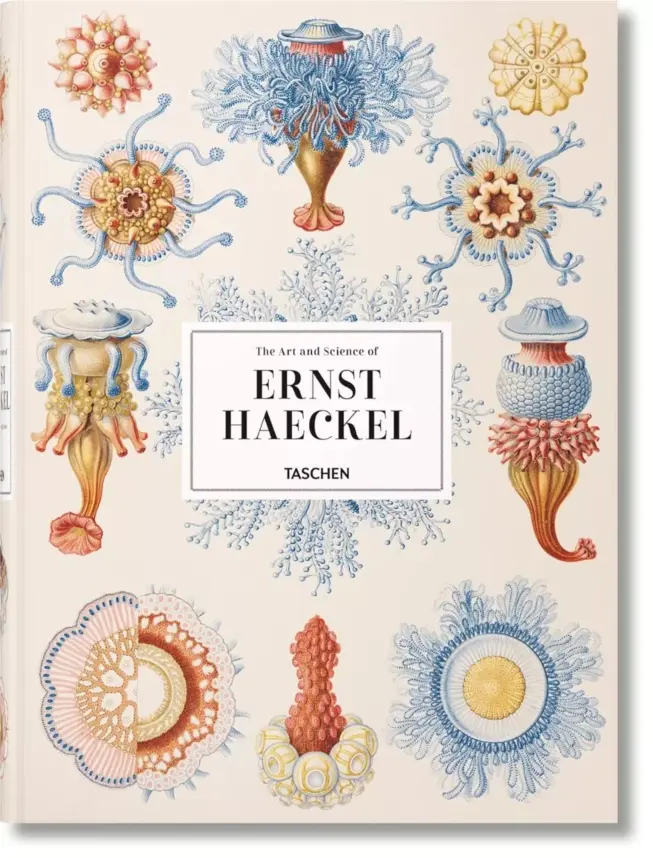
The art and science of Ernst Haeckel Extended Miscellaneous Spanish-English is available to buy in increments of 1
Add to Wish List
Ernst Haeckel (1834-1919) was a German biologist, naturalist, evolutionist, artist, philosopher and doctor, who devoted his life to researching the flora and fauna of both the highest mountain peaks and the deepest oceans. A fervent supporter and scholar of Darwin's theories of evolution, he denounced religious dogma, wrote philosophical treatises, earned a doctorate in zoology, and coined now commonly used scientific terms such as ecology, phylum and stem cell.
Haeckel's immense legacy has fascinated, baffled and polarised generations. But what was the essence of his extraordinary life's work? Like his intellectual predecessor, Alexander von Humboldt, Haeckel sought not only new discoveries but also explanations. To achieve his goal, he produced hundreds of drawings, watercolours and detailed sketches of his findings, which he published during the 20th century in a series of volumes, including several compilations of marine organisms and the majestic Kunstformen der Natur (Artistic Forms in Nature), which may well be the foundation of his lifelong project.
As a meticulous visual encyclopaedia of living things, Haeckel's work is as remarkable for its graphic precision and detailed shading as it is for its understanding of organic evolution. From bats to cubozoa, from lizards to lichens, from spider legs to sea anemones, he placed special emphasis on basic symmetries and natural order, discovering biological beauty in even the most unsuspected creatures. The plates, in addition to advancing the study of natural history, influenced generations of 20th-century artists and architects, from advocates of modernism to architects such as Hendrik Petrus Berlage.
This book pays tribute to the scientific, artistic and environmental importance of Haeckel's work with a collection of plates taken from several of his most important volumes on marine biology, including Die Radiolarien, Monographie der Medusen, Die Kalkschwämme and Kunstformen der Natur. At a time when biodiversity is increasingly threatened by human activities, this volume is at once a visual masterpiece, an underwater exploration and a vivid reminder of the beautiful diversity of life.
Pages: 704
Language: English
Author: Rainer Willmann, Julia Voss
Year: 2017
ISBN: 9783836526463
Publisher: Taschen
More Information
Brand
Editorial
Idioma
Inglés
The art and science of Ernst Haeckel Extended Miscellaneous Spanish-English
You are trying to visit Hartem UK website. Do you want to continue on this website?
https://hartem.com/en-gb/the-art-and-science-of-ernst-haeckel.html139671The art and science of Ernst Haeckel Extended Miscellaneous Spanish-English<p>Ernst Haeckel (1834-1919) was a German biologist, naturalist, evolutionist, artist, philosopher and doctor, who devoted his life to researching the flora and fauna of both the highest mountain peaks and the deepest oceans. A fervent supporter and scholar of Darwin's theories of evolution, he denounced religious dogma, wrote philosophical treatises, earned a doctorate in zoology, and coined now commonly used scientific terms such as ecology, phylum and stem cell.</p><p>Haeckel's immense legacy has fascinated, baffled and polarised generations. But what was the essence of his extraordinary life's work? Like his intellectual predecessor, Alexander von Humboldt, Haeckel sought not only new discoveries but also explanations. To achieve his goal, he produced hundreds of drawings, watercolours and detailed sketches of his findings, which he published during the 20th century in a series of volumes, including several compilations of marine organisms and the majestic Kunstformen der Natur (Artistic Forms in Nature), which may well be the foundation of his lifelong project.</p><p>As a meticulous visual encyclopaedia of living things, Haeckel's work is as remarkable for its graphic precision and detailed shading as it is for its understanding of organic evolution. From bats to cubozoa, from lizards to lichens, from spider legs to sea anemones, he placed special emphasis on basic symmetries and natural order, discovering biological beauty in even the most unsuspected creatures. The plates, in addition to advancing the study of natural history, influenced generations of 20th-century artists and architects, from advocates of modernism to architects such as Hendrik Petrus Berlage.</p><p>This book pays tribute to the scientific, artistic and environmental importance of Haeckel's work with a collection of plates taken from several of his most important volumes on marine biology, including Die Radiolarien, Monographie der Medusen, Die Kalkschwämme and Kunstformen der Natur. At a time when biodiversity is increasingly threatened by human activities, this volume is at once a visual masterpiece, an underwater exploration and a vivid reminder of the beautiful diversity of life.</p><li>Pages: 704</li><li>Language: English</li><li>Author: Rainer Willmann, Julia Voss</li><li>Year: 2017</li><li>ISBN: 9783836526463</li><p>Publisher: Taschen</p>https://static.hartem.com/media/catalog/product/t/h/the_art_and_science_of_ernst_haeckel.webp0instock159.380100159.38000https://static.hartem.com/media/catalog/product/t/h/the_art_and_science_of_ernst_haeckel.webp/Adult colouring books/Taschen/Colour and Art Theory Books1708888663000