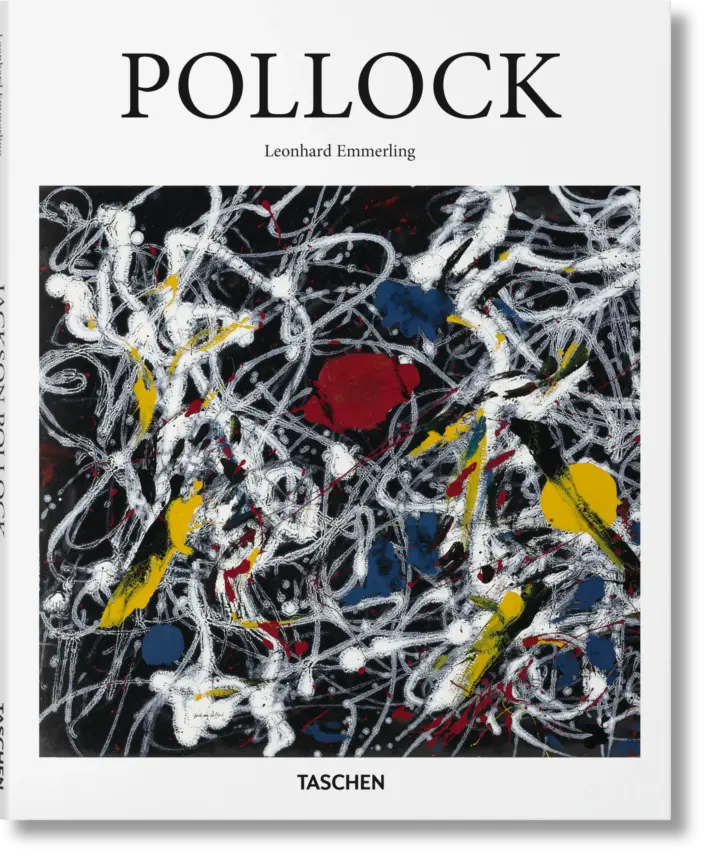
A rebellious hero of Abstract Expressionism, Jackson Pollock lit up the American art scene like a pyrotechnician during his lifetime, leaving a legacy that includes his energetic and explosive splatter paintings made with the technique of dripping. This essential introduction explores his work and his fame in order, through both, to understand the value of his masterpieces in modern art and his status as a cultural icon.
Abstract act
The explosive work of a cultural icon
A rebellious hero of Abstract Expressionism, Jackson Pollock (1912-1956) lit up the American art scene like a pyrotechnician during his lifetime. Channelling ideas from such disparate sources as Picasso and Mexican Surrealism, he rejected existing conventions in order to devise a personal way of looking, interpreting and expressing himself. Pollock's most famous works are his drip paintings, in which he dripped and poured enamel paint onto the canvas using a variety of instruments, from sticks to syringes to hardened brushes and even shards of glass. The resulting splashes are brimming with energy and replace the refinement of the easel and brush with something altogether more immediate, vivid and physical.To prevent the viewer from looking for figurative elements in his canvases, Pollock chose not to title them and simply identified them neutrally with a number. Known as a sullen, volatile man who struggled with alcoholism and married to fellow Abstract Expressionist artist Lee Krasner, Pollock, who died in a car accident when he was only 44, is a fascinating creative icon and art pioneer.This essential introduction to the artist explores both his work and his fame to understand the value of some of what are now essential masterpieces in modern history and his status as a cultural icon.
About the author
Leonhard Emmerling received his PhD from the University of Heidelberg with a thesis entitled "Art Theory of Jean Dubuffet". He directs the South Asia regional programme at the Goethe-Institut in New Delhi and previously curated exhibitions at various art institutions in Germany.
You are trying to visit Hartem UK website. Do you want to continue on this website?
https://hartem.com/en-gb/pollock-basic-art-series.html158568Basic Art Series Pollock L Emmerling English<p>A rebellious hero of Abstract Expressionism, Jackson Pollock lit up the American art scene like a pyrotechnician during his lifetime, leaving a legacy that includes his energetic and explosive splatter paintings made with the technique of dripping. This essential introduction explores his work and his fame in order, through both, to understand the value of his masterpieces in modern art and his status as a cultural icon.</p><p>Abstract act</p><p>The explosive work of a cultural icon</p><p>A rebellious hero of Abstract Expressionism, Jackson Pollock (1912-1956) lit up the American art scene like a pyrotechnician during his lifetime. Channelling ideas from such disparate sources as Picasso and Mexican Surrealism, he rejected existing conventions in order to devise a personal way of looking, interpreting and expressing himself.<br/>Pollock's most famous works are his drip paintings, in which he dripped and poured enamel paint onto the canvas using a variety of instruments, from sticks to syringes to hardened brushes and even shards of glass. The resulting splashes are brimming with energy and replace the refinement of the easel and brush with something altogether more immediate, vivid and physical.To prevent the viewer from looking for figurative elements in his canvases, Pollock chose not to title them and simply identified them neutrally with a number.<br/>Known as a sullen, volatile man who struggled with alcoholism and married to fellow Abstract Expressionist artist Lee Krasner, Pollock, who died in a car accident when he was only 44, is a fascinating creative icon and art pioneer.This essential introduction to the artist explores both his work and his fame to understand the value of some of what are now essential masterpieces in modern history and his status as a cultural icon.</p><p>About the author</p><p>Leonhard Emmerling received his PhD from the University of Heidelberg with a thesis entitled "Art Theory of Jean Dubuffet". He directs the South Asia regional programme at the Goethe-Institut in New Delhi and previously curated exhibitions at various art institutions in Germany.</p><li>Pages: 96 </li><li>Language: English</li><li>Author: Leonhard Emmerling</li><li>Year: 2016</li><li>MODEL: 9783836529075</li><p>Publisher: Taschen</p>https://static.hartem.com/media/catalog/product/8/8/Pop-Art_1.webp0outofstock12.75010012.75000https://static.hartem.com/media/catalog/product/8/8/Pop-Art_1.webp/Novedades de Bellas Artes/Taschen/Fine Arts Books/Fine Arts Books/Colour and Art Theory Books1743037248000